
AKEMI HORIE
theatre/opera director, film maker

Musician,
choreographer and academic.
Studied with Jan Kott, whose radical approach to the theatre
has been influential.
Research fields:
Sophocles, Noh and Samuel Beckett.
Expert
on Kabuki and
Noh theatres. Pioneered
experimental work interpreting
the Noh aesthetics
and dramaturgy in modern theatrical terms.
Japanese citizen; UK
resident. Brief
Biography
Contact
BA: Humanities,
International Christian University, Tokyo
MFA:
Theatre Arts, School of Fine and Applied Arts, Boston University.
PhD:
Dramatic Art, University of California, Berkeley
Film
making: New York Film Academy
As
a theatre director my work is distinctly minimalist achieving powerful
strikingly visual theatricality with the sparest of means.
"Compelling", "restrained but eloquent", "utterly
clear and focused", "incredibly pure", "incredibly
strong" are some of the comments by reviewers on my recent productions. I
thrive on the spatial constraints of theatre, which compel inventiveness;
equally I relish the visual and temporal freedom in film storytelling.
AMONG PLAYS
DIRECTED: The Cyclops (Euripides); Blood Wedding (Lorca); The Choephori (Aeschylus); The Well-Stone (Zeami); Sotoba Komachi (Kan'ami); The Wild Duck (Ibsen); Three Sisters (Chekhov); Friends (Abe); The Dreaming of the Bones (Yeats); Endgame, Come and Go, Krapp’s Last Tape (Beckett); The Cliff of Time (Abe); Vatzlav (Mrozek); Kesho (Inoue). World premieres of Paul Barker's operas The Pillow Song and Malinche for the London International Opera
Festival. One Night or Day, a short film based on Samuel
Beckett's Stirrings Still, One Evening & Krapp's Last Tape.
WORK
IN PROGRESS
Yabu
no Naka (In the Grove) A Cubist
vision of a whodunnit, a stage adaptation of the short story by Ryunosuke
Akutagawa (1892-1927). The tale famously inspired Kurosawa's film classic Rashomon. A body is found in the grove: the
drama unfolds in a manner reminiscent of Brecht's The Measures Taken. The witnesses' conflicting
accounts of the crime, a rape and murder, illuminate the elusive nature of
truth. At the centre is a young woman, the enigma who provokes, propels, and
finally veils the action/truth. An experimental piece involving recitative,
mime, sound (percussion & flute) and projected moving images. The stage is
almost bare, defined only by several bamboo trees shooting out from the centre
in all directions.
Five
Easy Pieces 'Journeying' is an eternal metaphor for
life, and writers have addressed this theme since time immemorial. A collection
of five short scenes constructed respectively from tales of ancient Greece,
medieval Japan, the Middle East, modern and post-modern Europe will explore the
subject. Each man, or woman, has a story to tell and a journey to take,
ultimately expressing their common humanity. A spare, minimalist production.
King
Lear A stripped-down essential
Shakespeare. Lear's story is well known. Can his
tragedy be presented with a minimum of narrative and decor, and be all the more
powerful for it?
The
Persians Aeschylus recounts the catastrophic defeat of the Persians in
the Battle of Salamis (480BC), in which he himself took part. With its strong
anti-war message and a substantial Chorus part, the world's oldest extant play
(472BC) provides the basis for a powerful operatic production. Suspended after
several years of preparatory work due to lack of the substantial funding
required.
SELECTED WORKS
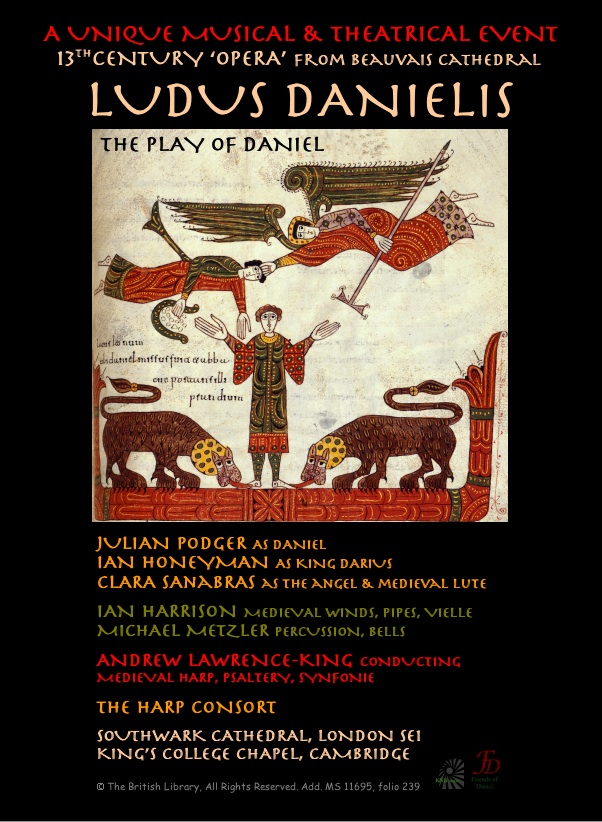
Ludus
Danielis
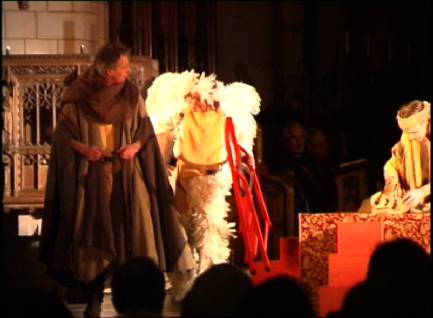
A rarely staged 13th century
music drama based on the biblical tales of the exiled prophet Daniel. First
performed by the young clerics of Beauvais Cathedral, Northern France, this
medieval masterpiece combining music, poetry and visual spectacle formed part
of the post-Christmas celebrations. Produced in collaboration with The Harp Consort, the première performances took
place in January 2007 at Southwark Cathedral, London, and King’s College
Chapel, Cambridge. Despite its Latin text, Ludus Danielis received enthusiastic responses from
the audience and the press. More
on Daniel
Video Clips More Pics Flyer front & back
Review
“Southwark
Cathedral forms a stage-set beyond compare, while on a dais in the middle of
the chancel stands an elongated red-lacquer chair, like a ladder to heaven: the
sole prop that the director Akemi Horie has permitted herself. . .
As a musical event, this would charm the birds off the trees.
The timbre of the male singers - led by the baritone Peter
Harvey and tenor Julian Podger - reflects classical
polish, while the female singers, though pure-toned,
favour a folky kind of belt.
,
What unites them, however, is a beguiling blend of conviction
and joie de vivre, plus a uniquely deft mix of medieval musical sounds. Having
taken the surviving manuscript's minimalism as their cue for harmonic
inventions, the modal music that results creates a wonderfully dreamy ambiance.” Michael Church, opera critic of The
Independent, giving 5 stars. Daniel
Review in full
Contemporary
Noh
A
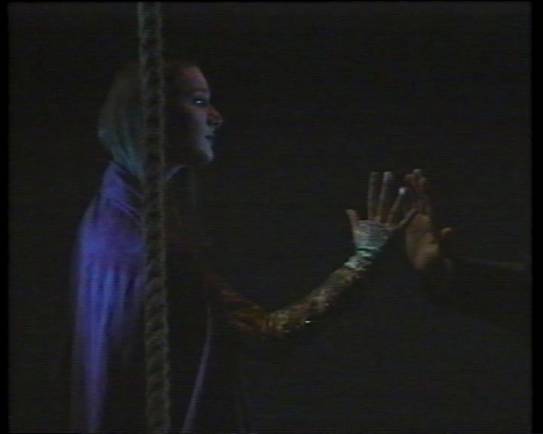
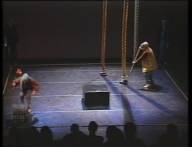
trilogy comprising the 14 century Noh play Sotoba Komachi, the kyogen The Melon
Thief and Journey, a collage based on three works of
Samuel Beckett, Waiting for Godot, Endgame and Worstward Ho.
 On the Noh stage, time takes on
non-monotonic references, the past is in the present and the phenomenal world
merges into the worlds beyond.
On the Noh stage, time takes on
non-monotonic references, the past is in the present and the phenomenal world
merges into the worlds beyond.
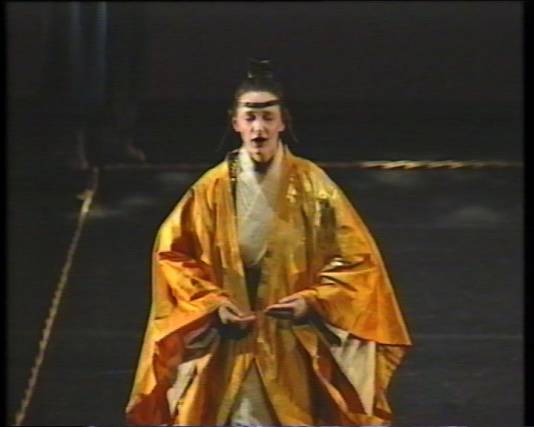
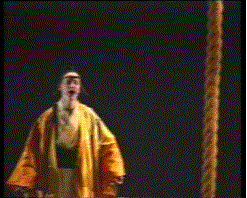
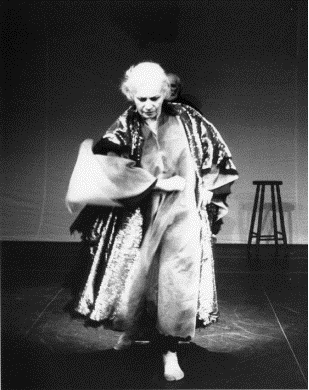
 Sotoba Komachi recounts the tale of a 9th century
historical figure, once a legendary beauty, now cursed to live on in
decreptitude possessed by the vengeful spirit of a taunted suitor. An encounter
between two pilgrim monks and a mysterious old woman unfolds the drama. The Noh
classic by Kan'ami (1336-1383) is performed with new music and choreography,
initiating
an aesthetic and thematic journey into the post-modern world of Samuel Beckett.
Sotoba Komachi recounts the tale of a 9th century
historical figure, once a legendary beauty, now cursed to live on in
decreptitude possessed by the vengeful spirit of a taunted suitor. An encounter
between two pilgrim monks and a mysterious old woman unfolds the drama. The Noh
classic by Kan'ami (1336-1383) is performed with new music and choreography,
initiating
an aesthetic and thematic journey into the post-modern world of Samuel Beckett.
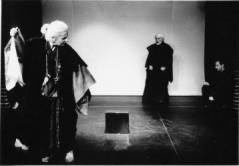
Journey, echoing the Noh dramaturgy, portrays a chance encounter between
Clov of Endgame, on his perpetual journey in limbo since leaving Hamm, and
the two men on a country road still waiting for Godot. What message would Clov
impart to the two waiting men? A single soprano voice as the Chorus sings
unaccompanied passages from Worstward Ho. Clov is also heard muttering words
from it as he journeys on.
The
Melon
Thief,
an anonymous medieval comic interlude (kyogen) performed here in a timeless
universal context, bridging the two distinct worlds of Kan'ami and Beckett.
The
project interprets the medieval Japanese Noh in a modern theatrical context and
illuminates a certain affinity between the world visions of Noh and Samuel
Beckett.
 In summer 1989 I wrote to
Beckett explaining the project and how I would combine his three works in a
collage in Noh form. A copy of
Sotoba Komachi was also sent. I
was taking great liberties with his works by assuming that Clov indeed left
Hamm at the end of Endgame and by postulating a chance encounter between Clov
and the two waiting men. I
mentioned also that the three characters would speak selected lines from his
plays in the collage, and that the Chorus would sing, and Clov would speak,
passages from Worstward Ho. Beckett
gave me permission to proceed, with brief but kind words of encouragement.
In summer 1989 I wrote to
Beckett explaining the project and how I would combine his three works in a
collage in Noh form. A copy of
Sotoba Komachi was also sent. I
was taking great liberties with his works by assuming that Clov indeed left
Hamm at the end of Endgame and by postulating a chance encounter between Clov
and the two waiting men. I
mentioned also that the three characters would speak selected lines from his
plays in the collage, and that the Chorus would sing, and Clov would speak,
passages from Worstward Ho. Beckett
gave me permission to proceed, with brief but kind words of encouragement.
Journey:
A Variation on Beckett
Journey
Score
Komachi Score with Text
Reviews
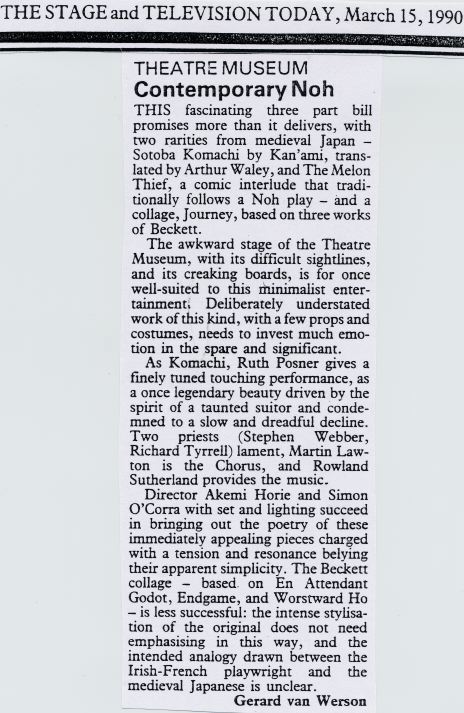
"Deliberately
understated work of this kind, with a few props and costumes, needs to invest
much emotion in the spare and significant… Director Akemi Horie and Simon O'Corra with set and lighting
succeed in bringing out the poetry of these immediately appealing pieces
charged with a tension and resonance belying their apparent simplicity…" Gerard van Werson, The
Stage Werson
in full
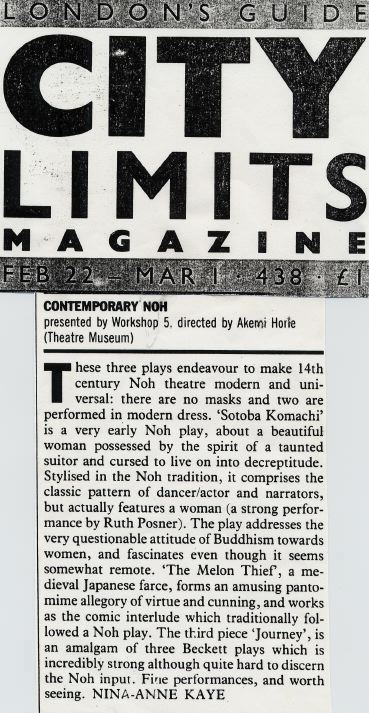
"These three plays endeavour to make 14th century Noh
theatre modern and universal: there are no masks and two are performed in
modern dress… The third piece Journey is an amalgam of three Beckett plays,
which is incredibly strong although quite hard to discern the Noh input. Fine
performances, and worth seeing." Nina-Anne Kaye, City Limits Kaye
"This profound piece is striking for its sombre philosophy
and vibrant poetry, both expressed with quiet strength and atmospheric
elegance…" Brian G Cooper, The
Stage Cooper
Performers:
Ruth Posner (Komachi), Martin Lawton (Chorus, Didi), Richard Tyrrell (Priest,
Clov), Stephen Webber (Priest, Gogo). Musicians: Amanda Broome (soprano);
Rowland Sutherland (wind instruments & drums). Direction & choreography: Akemi Horie. Music: Ho Wai-On. Lighting & set: Simon O'Corra. Costumes: Dawn Allsopp. Translation of Komachi text: Arthur Waley.
Performed
at Theatre Musium, London, WC2; Komachi also
at
ICA, London SW1; Lilian Baylis Theatre, Sadler’s Wells, London EC1
Vatzlav A satirical farce by the Polish
playwright Slamomir Mrozek, riotously performed at the Edinburgh Festival
Fringe. Vatzlav, a shipwrecked runaway slave, is washed up on the shore of a
capitalist colony, ruled by the raspberry-sucking Mr Bat and his dysfunctional family.
Forced to impersonate a bear, he fights off each peril with streetwise
ingenuity, turning young Justine/Justice into a striptease performer and
himself into a capitalist entrepreneur along the way. Then comes the revolution
-
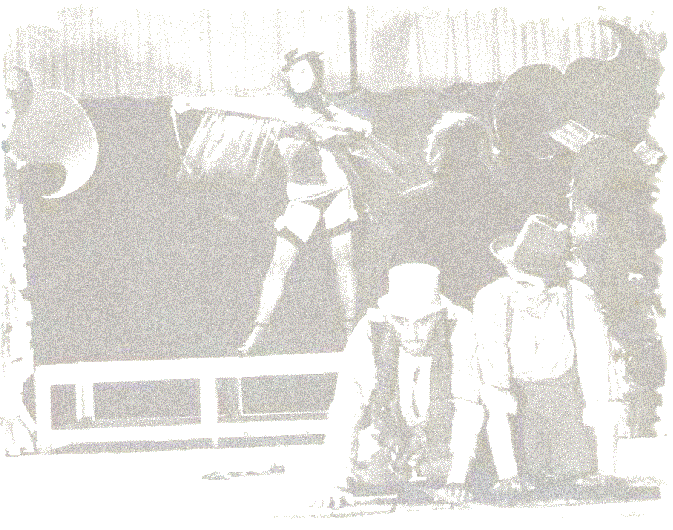
 77 short scenes were performed at a
rapid tempo, like a comic strip, with the actors moving portable scenery,
cardboard trees, stools etc., setting their own scenes. Vatzlav
Stills
77 short scenes were performed at a
rapid tempo, like a comic strip, with the actors moving portable scenery,
cardboard trees, stools etc., setting their own scenes. Vatzlav
Stills
Reviews
"A rich experience, a web of spreading images… The small cast of Cambridge Actors
Workshop conjures up a remarkably complete caricature of society. The piece is
loud and colourful and has an engaging tendency to shoot off in all directions
while retaining a sort of loony unity. Zany…" Colin Currie, The Scotsman
"The Actors
Workshop in Cambridge staged Waclaw (Vatslav) at this year's
Edinburgh Festival Fringe. I wish
to emphasize the full success achieved by this ambitious and talented young
group of actors. In large measure this is due to the work of the director,
Akemi Horie, a Japanese lady, who with unusual sensitivity managed to penetrate
the strange atmosphere intended and created by the author… the result of which
has been not so much a philosophical play but a clever sharp political satire." Tadeurz Ziarvki, The Polish Daily
(Translated from Polish).
Performers: Bruce Addison (Vatzlav),
Beatrice Braude (Lackey), Nicholas Frankau (Sassafras), Robin Frost
(Quail, Genius), Eithne Hannigan
(Justine), Craig McConnell (General Barbaro), Mavis Mitchell (Mrs.Bat), Stephen
Reed (Mr.Bat, Oedipus, Executioner), Richard Sisson (Bobbie). Direction: Akemi Horie. Designs: Sarah
Percy-Lancaster. Lighting: Ian
Larkin. Sound: Nick Brown. Performed
at Corn Exchange, Cambridge; Walpole Hall, Edinburgh.
Three
Sisters The late Chekhovian plays, though rooted
in the Naturalistic convention, contain the seeds of the modern Absurdist
vision, culminating in the works of writers such as Samuel Beckett. Indeed the
thematic parallels between Three Sisters and Waiting for Godot, and The Cherry Orchard and Endgame, are remarkable.
In
Three Sisters
in particular, the Naturalistic form often seems to be disrupted by Chekhov's
apparent impulse to create a concrete Absurdist vision on stage. Observe the
loose
episodic structure of the play; the metaphors, flowers, wintry wind, fire, dead
trees defining each act; the heightened, almost grotesque characterization of
Andrey, Natasha, Soliony and Koolyghin; the seemingly unrelated dialogues,
asides and bursts of laughter in the background commenting on the main action
on stage, like a Chorus. And mythical 'Moscow', like Godot, hangs over the
entire play.
In
this production the sunny flower-filled opening scene is progressively stripped
bare as the play moves towards a bleak landscape of fading hopes. Performed
with the minimum décor, without four walls, without intermission, to bring out
the essentials of the play.
Review:
"I loved it -
it was so well-laid out before me; I felt there was so much going on. Your
production has converted me to this play, for the first time, even though I had
already seen several productions…"
Letter from Paul Chand,
critic and friend.
SLIDE SEQUENCES ACT1 - IV Sisters Slides Show
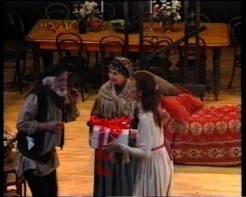
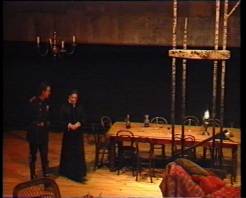
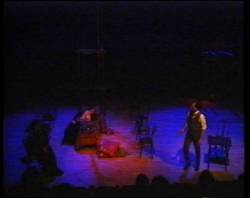
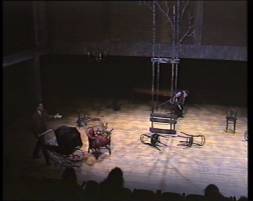
VIDEO CLIP: Irena
Crisis Act lll
QuickTime streaming. Recorded at Lilian Baylis Theatre, Sadler's Wells, London
EC1
Performers:
Silas Hawkins (Andrey), Ruth
Bennett (Natasha), Michaela
Burgess (Olga), Sarah Montague
(Masha), Josephine Peer
(Irena), Garry Scanlan
(Koolyghin), Leslie Aston
(Vershinin), Tim Mitchell
(Toozenbach), Andy Blacksmith
(Soliony), Richard Gofton
(Chebutykin), David Hallen
(Fedotik, Rode), Stephen Bateman
(Ferapont), Ruth Posner
(Anfisa). Translation by Elisaveta
Fen. Direction: Akemi Horie. Designs: Anabel Temple. Lighting: Ian Watts.
Olga Knipper (the author's wife and the first
Masha) recalls in her memoir that when Chekhov gave the first reading of the
play at the Moscow Arts Theatre in October 1900, the dismayed actors reacted
that the play was only a "sketch" or "outline" with
"no fully developed characters." Chekhov, smiling in embarrassment and coughing intensely,
responded that he had only written "a light-hearted comedy." Stanislavsky (the first Vershinin) also
recalls that Chekhov was convinced that the play was incomprehensible and
destined to fail. Three Sisters
premiered on 31 January 1901 at the Moscow Arts Theatre. The initial press
response was mixed: "a major event", "too pessimistic and
hopeless", "puzzling indistinctness of plot and character
motivation" - somewhat reminiscent of the press reception that was to
greet the première of Waiting for Godot half a century later.
Resonances
of Passion A programme of two Noh plays,
pairing the medieval classic Izutsu by Zeami (1362-1443) with a modern western counterpart, The
Dreaming of the Bones by W.B. Yeats.
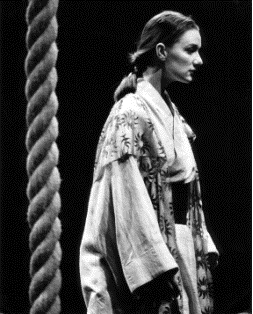
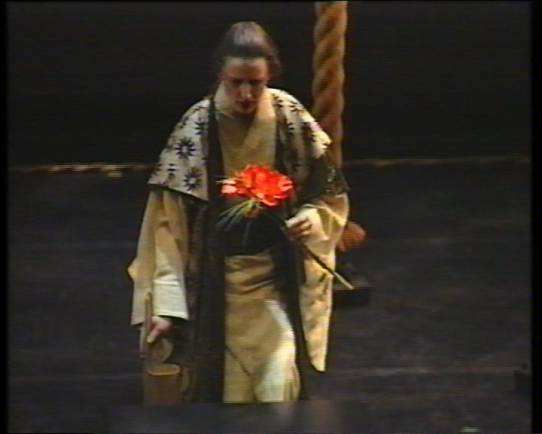
Izutsu (The Well-Stone) tells the story of a woman whose
spirit has remained attached to the locus of her passion for centuries after
her death. The encounter between a pilgrim monk and a young woman at an old
abandoned temple unfolds the drama.
The
heroine, Ki no Aritsune's daughter, was a 9th century historical figure. Her
lover, Ariwara no Narihira (825-880), was a poetic genius, renowned also for
his handsome and amorous persona. His poems, and several of hers, appear in the
anthology Kokinshu compiled
in 905. Several
of love poems they exchanged are woven into the play. As Zeami tells it, the
old well in these abandoned temple grounds, where she appears, was where the
two once played as children.
In
The
Dreaming
of
the
Bones
(1919) Yeats applies the Noh formula to a political subject - the historical
roots and aftermath of the 1916 Easter Rising. A young Nationalist fugitive
meets a mysterious couple when lost in the mountains. He has fought in Dublin
and will be shot if he is caught. The couple offer to guide him to safety, but
they want something in return - something he cannot or will not give.
The
mysterious pair are revealed to be Diarmuid MacMurrough (1100-71), King of
Leinster, and his lover Devorgilla, wife of the Lord of Breifne. As the legend
has it, their fatal passion led to MacMurrough’s banishment. He then fled to
England and, licensed by Hentry II, enlisted volunteers and invaded his own
country, capturing Dublin in 1170. The Anglo-Norman occupation of Ireland
remained until well into the 20th century.
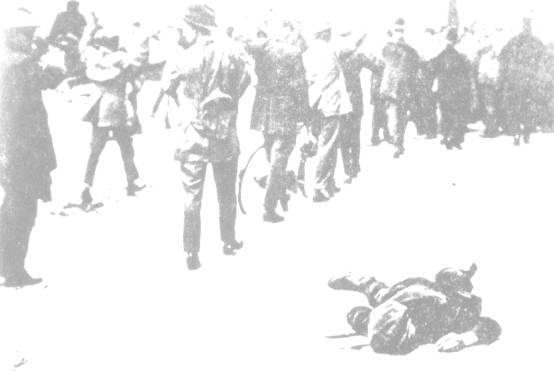 Yeats was greatly inspired by
the Noh theatre via his young friend Ezra Pound. Here the urgent political theme is given a poetic aspect
with its mythical dimension drawing on old Celtic beliefs. The play was not performed until 1931
because of its political content, which Yeats himself feared might be "too
powerful".
Yeats was greatly inspired by
the Noh theatre via his young friend Ezra Pound. Here the urgent political theme is given a poetic aspect
with its mythical dimension drawing on old Celtic beliefs. The play was not performed until 1931
because of its political content, which Yeats himself feared might be "too
powerful".
Performed
with the minimum of décor, six actors and two musicians (wind instruments and
percussion). The Irish composer Paddy Cunneen created the music for both plays
through exploratory workshops.
Programme notes on plays, authors & history
Reviews
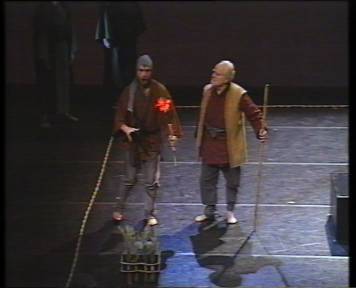
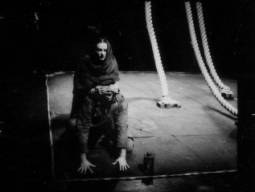
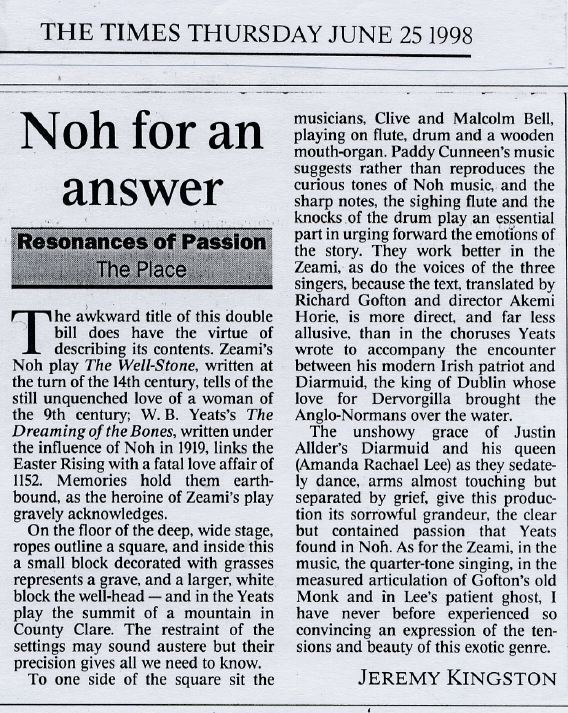
"On the floor of the deep, wide stage, ropes outline a
square, and inside this a small block decorated with grasses represents a
grave, and a larger, white block the well-head - and in the Yeats play the
summit of a mountain in County Clare.
The restraint of the settings may sound austere but their precision
gives all we need to know. On one side of the square sit the musicians … The unshowy grace of Justin Allder's
Diarmuid and his queen (Amanda Rachael Lee) as they sedately dance, arms almost
touching but separated by grief, gives this production its sorrowful grandeur …
I have never before experienced so convincing an expression of the tensions and
beauty of this exotic genre."
Jeremy Kingston, The Times Kingston
in full
 "Yeats, himself
aiming at a meeting of East and West, was remarkably well served. Poetry flared briefly in our
imaginations, and in its reflected glow theatre came gloriously alive." Nicholas Dromgoole, The
Sunday Telegraph
"Yeats, himself
aiming at a meeting of East and West, was remarkably well served. Poetry flared briefly in our
imaginations, and in its reflected glow theatre came gloriously alive." Nicholas Dromgoole, The
Sunday Telegraph
"The staging is simple and incredibly pure, the performers
creating just exactly the right degree of stylization for their performance,
able to make the poetic text both believable and appropriately symbolic… Paddy Cunneen (composer) has really
crafted a Britten-like opera… The sound hovered creatively between Japanese and
Western styles (with fantastic playing of Japanese instruments) creating a multi-cultural,
kaleidoscopic experience. The
direction stands out as peculiarly restrained yet eloquent - simple images and
extraordinarily slow pacing made the experience almost like a meditation,
possibly a little austere, but utterly clear and focused …" Arts Council
VIDEO CLIPS QuickTime streaming. Edited in part. Recorded at The Place Theatre, London
WC1
Izutsu 1 Opening Yeats
1 Opening
Izutsu 2 Entrance Yeats
2 Encounter
Izutsu 3 Story Yeats
4 Near Summit
Izutsu 4 Childhood Yeats
5 Dance & Last Chorus Song
Izutsu
5 Comic Interlude (silent, double speed)
Performers:
Amanda Rachael Lee (Young Woman), Justin Allder (Villager, Stranger), Reg Eppey
(Chorus/Baritone), Richard Gofton (Monk, Chorus/Tenor), Walter Van Dyk
(Narihira, Chorus/Tenor), Andy Wisher (Young Man, Chorus/Bass). Musicians: Clive Bell (wind instruments
& electric harp), Malcolm Ball (percussion). Direction, design, choreography: Akemi Horie. Music: Paddy Cunneen. Lighting: Simon Bennison, Neil
Fraser. Costume, props: Jess
Curtis. New translation of Izutsu by Richard Gofton with Akemi Horie
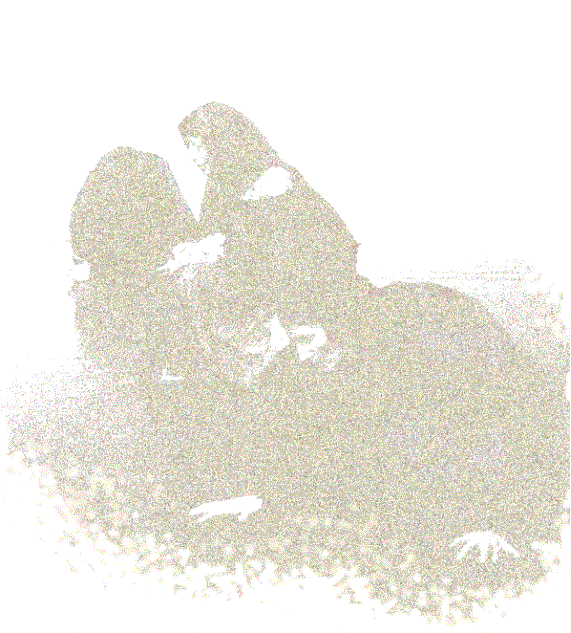 The Choephori An
exploration of the
second play of Aeschylus' trilogy The Oresteia. In his version of the myth,
Orestes and Electra are impressionable youths, uncertain and fearful of their
god-ordained task of revenge. They must rely on the guidance of the Chorus, who
are themselves enslaved Trojan women and can only give voice to the forces of
Nemesis.
The Choephori An
exploration of the
second play of Aeschylus' trilogy The Oresteia. In his version of the myth,
Orestes and Electra are impressionable youths, uncertain and fearful of their
god-ordained task of revenge. They must rely on the guidance of the Chorus, who
are themselves enslaved Trojan women and can only give voice to the forces of
Nemesis.
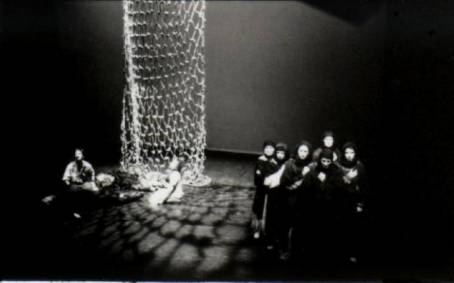
In this production
the Chorus, voicing the law of vengeance, speak in the original Greek, a
language that the young heroes do not comprehend at first, indeed the sound of
it frightens them. But inevitably they will begin to copy the alien phrases,
word by word. By the time they carry out the matricide, they have come to speak
the language of Nemesis fluently.
Reviews
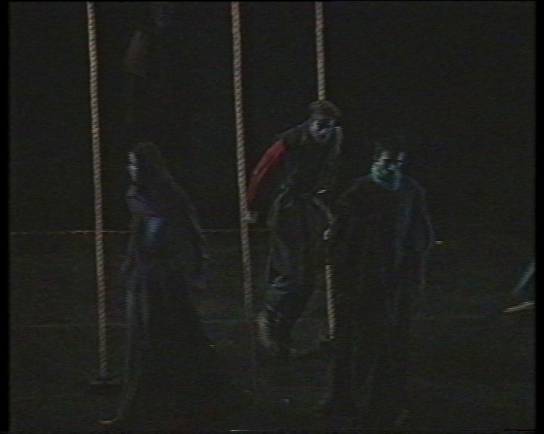
"Akemi Horie's production makes explicit this metaphor of
enmeshment. Various contrasting nets envelop the stage and are used to good
effect… Quite a lot of the original Greek is retained, combined with the fluent
Chicago translation. It is most impressive when being intoned by the chorus of
bitter slave women, especially where they urge on Electra and her brother to
revenge. The harshness and foreboding of the intonation is matched by the
almost aggressive asymmetry of the positioning of actors on stage (How
refreshing not to see a static chorus) and the atonality of the accompanying
Tibetan music (which is reminiscent of the African music in Pasolini's Oedipus
Rex)." Cambridge University Broadsheet
"The chilling intensity of the drama with the remorseless
chanting of the Greek chorus and the stark imagery of the huge net of death is
both compelling and engrossing…"
Brian Cooper, The Stage
Cooper
in full
Choephori
Stills Cambridge & London productions,
with a different cast.
Performers for the London production at ICA & Lillian Baylis: Laurissa Kalinowsky (Electra), Peter Kenny (Orestes), Julia Righton (Clytemnestra), Christopher Brown (Aegisthus), Martin Lawton (Agamemnon), Joolia Cappleman, Liz Dickinson, Philippa Luce, Ruth Posner, Deborah Shipley, Joyce Springer (Trojan Women). Direction, design & choreography: Akemi Horie. Lighting: Ian Watts. Costume: Jacqueline Fitt.
Kesho
& Toki no Gake
Two contemporary Japanese plays
representing the two main streams of modern Japanese Theatre.
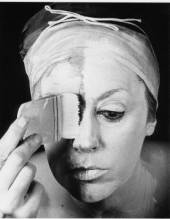
In
Kesho (Make-up), Hisashi Inoue (1934-2010), writing in the wholely
home-grown literary tradition, weaves an ingenious mono-dialogue probing the
mind of actress-manager Satsuki of a strolling kabuki troupe - a dying tradition in
contemporary Japan.
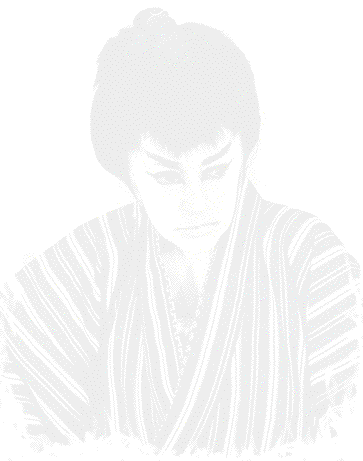 In her dressing room, she is making
up as the young outlaw hero she is about to play. She is alone on stage, though
talking to her actors apparently off stage. As she begins to rehearse her
lines, moving in and out of the play within a play, the story of the young
outlaw, searching for his birth mother, and her own story of a long lost son,
begin to intersect, with the borderline between what is real and fictional
becoming increasingly blurred. The invisible characters Satsuki led us to
believe in now appear only figments of her imagination. As the raucous cries of
demolition men off-stage intrude on her make-believe, the evening seems no
longer a routine: all along, it seems, she was play-acting all alone in an old
deserted theatre about to be bulldozed - her time is up. Kesho
Stills
In her dressing room, she is making
up as the young outlaw hero she is about to play. She is alone on stage, though
talking to her actors apparently off stage. As she begins to rehearse her
lines, moving in and out of the play within a play, the story of the young
outlaw, searching for his birth mother, and her own story of a long lost son,
begin to intersect, with the borderline between what is real and fictional
becoming increasingly blurred. The invisible characters Satsuki led us to
believe in now appear only figments of her imagination. As the raucous cries of
demolition men off-stage intrude on her make-believe, the evening seems no
longer a routine: all along, it seems, she was play-acting all alone in an old
deserted theatre about to be bulldozed - her time is up. Kesho
Stills
In
Toki no Gake (The Cliff of Time), Kobo Abe (1924-1993), representing the
post-modern vision, spins out the fragments of thoughts that pass through the
mind of a young boxer as he fights in the ring. His mind's monologue floats
over the noise and commotion of the fight, interrupted now and then by his
trainer's urging voice, which momentarily jolts him back to the bout at hand.
The boxer fights on the cliff of time up to the fourth round, then it seems he
is finished. The acclaimed author of Woman in the Dunse (film version Cannes Palme d'Or), Abe wrote this
short piece for his trilogy Bo ni Natta Otoko (The Man Who Turned into a
Stick).
His writing is often compaired to the works of Kafka, Arrabal and Ionesco.
Reviews
Kesho "The lights go up on a
dressing room and the recumbent form on the floor of Yoko Satsuki, the
actress-manager of a band of strolling players who keep alive the faded tradition
of popular kabuki style period melodrama. With a scratch of her bottom, she
awakes to prepare for her role as Isaburo, a young outlaw hero… The dividing-line between the
play and the play within the play is so skilfully blurred that the two lives
frequently meld into one." John Coldstream, The
Daily Telegraph
Toki no Gake "On a darkened stage
the only objects visible are a red punch-bag, a line of vertical ladders and
the spot-lit head and shoulders of Richard Tyrrell playing a young boxer steeling
himself for the fight he must win or forfeit his vital ranking. The thoughts he speaks alternate
between foolish hope and panic, unconsciously humorous (a balance neatly
achieved in Donald Keene's translation) and dreamily poetic. The shadows of his boxing fists flicker
at the periphery of the spot-lit area but the gathering drama is measured in
the subtle changes in Tyrrell's face (imagine Kafka with a grin) and his
feverish nerviness of voice."
Jeremy Kingston, The Times
"A brilliantly clear, economical style" Paul Chand, The Stage
Performers: Jackie Skarvellis (Yoko Satsuki), Richard Tyrrell
(Boxer), James Ramsey (Voice)
Direction:
Akemi Horie. Designs: Jan Blake.
Lighting: Tina MacHugh.
Translations:
Toki no Gake
by Donald Keene; Kesho by Akemi Horie, published with Notes on the Background of Kesho in Encounter No.5, 1989.
Performed
at Bloomsbury Theatre, London WC1
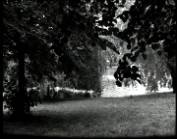
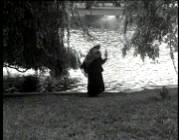
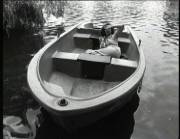
 One Night or Day A short film inspired by an evocative passage in Krapp's Last Tape recalling the end of his love affair
on a sunny lake distant years ago. Krapp's apparent attachment to this segment
of his tape/life, to which he returns to listen again at the ending, is ironic and deeply
moving. Elements from Beckett's
One Night or Day A short film inspired by an evocative passage in Krapp's Last Tape recalling the end of his love affair
on a sunny lake distant years ago. Krapp's apparent attachment to this segment
of his tape/life, to which he returns to listen again at the ending, is ironic and deeply
moving. Elements from Beckett's 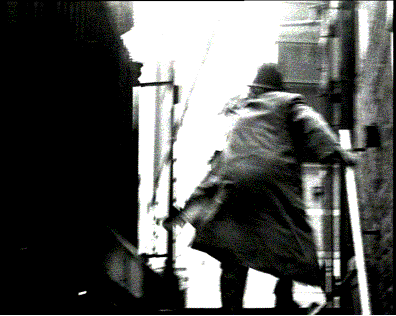 short stories Stirrings Still and One Evening are also incorporated in the
narraive.
short stories Stirrings Still and One Evening are also incorporated in the
narraive.
Here,
Krapp has kept a record of his life's events on 16mm film. In his dotage he
lives alone surrounded by loose filmstrips - fragments of his life - and spends
his days labouriously rewinding them back onto their reels. On this particular
night or day, he comes across the alluring image of a young woman in a boat.
Memories flood back, and her enigmatic smile lures him out to the street and to
the upper lake, apparently the locus of their last rendezvous.
The
camera follows the old man's real or imagined journey to the lake. Shot in
black and white with an Arriflex 16mm camera.
Key
Passages from Krapp's Last Tape, Stirrings still, One Evening
Script One Night or Day
One Night or Day digitally edited abridged version, single sound
track.
Performers:
Phyllida Bannister (Young Woman), Richard Gofton (Old Man), Ruth Posner (Old
Woman).
Writer/Director/Editor:
Akemi Horie. Director of
Photography: Deena Lombardi.
Assistant Camera: Zac De Santiago.



miscellaneous
Friends
A whimsical black comedy by Kobo Abe
(see Toki
no Gake above). A family of eight is on a mission
to search out a lonely soul upon whom to bestow their love and friendship.
Inviting themselves into a young man's flat, they take over his household, and
his fiancée, devouring him with their love and attention in the end. Even the
police, called in to investigate their forced entry, cannot detect anything
sinister in the smiling faces of the friendly family. Performed in the round in
Donald Keene’s translation at the Questors Theatre, London W5. Friends Stills
Japanese Theatre and the West An
International Theatre Symposium, aiming to promote creative interactions
between the Japanese and Western theatres. Organized for the Japan Festival 91
in association with the Institute of Contemporary Arts, London, and the Japan
Research Centre, SOAS, University of London. The meeting assembled leading
scholars and artists in the field from sixteen nations, with Jan
Kott (Poland), Georges Banu (France), Leonard Pronko (USA), Nicola Savarese
(Italy), Zvika Seper (Israel) and Yasunari Takahashi (Japan) among the
contributors. Also participating were three performing companies, Pohlyboveho
Divadla (Czech Republic), Umewaka Noh Troup (Japan) and Workshop 5 (UK). The four-day event held at the ICA
comprised a programme of lectures, demonstrations, workshops and performances.
The proceedings were published by Harwood Academic Publishers in 1994, as a
special edition of Contemporary Theatre Review, Japanese Theatre and the
West,
edited
by Akemi Horie-Webber
Comments on current
affairs Click
Extracurricular Click